The Model
NoirmakStyle
Redacted Bodies explores the censorship and surveillance of queer bodies—who is allowed to be visible, who is erased, and what happens when identity is interpreted by systems built to classify and observe us.
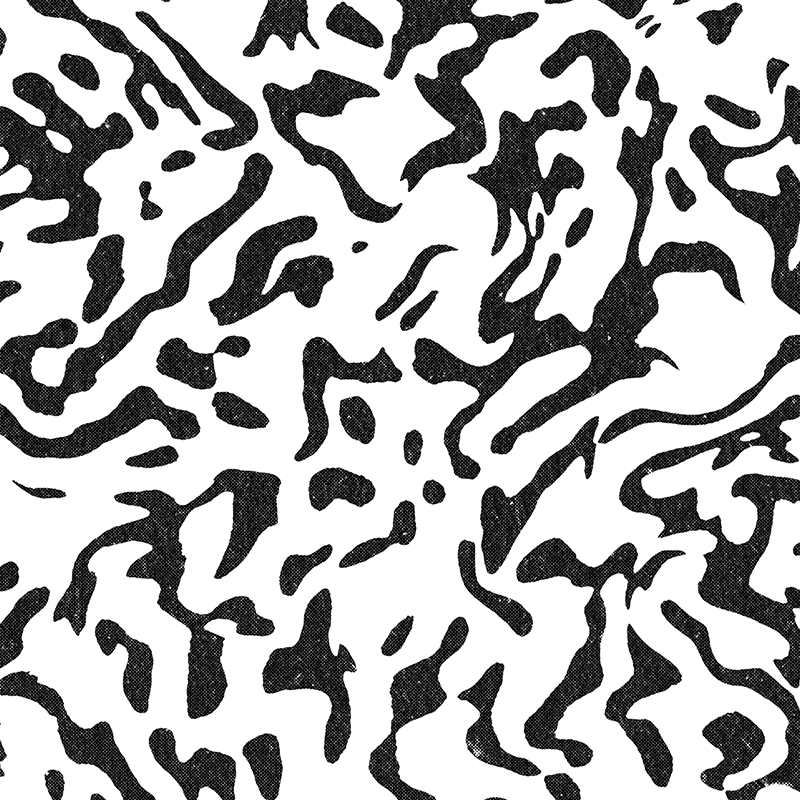
To create the collection, I trained NoirmakStyle, a custom AI image model built from a small, hand-curated dataset of my own artwork. The source images originated from a live-coded Hydra performance and were selected to teach the model a visual language of redaction, distortion, fragmentation, and transformation.
Rather than using AI simply to generate images, I treat the model itself as an artistic medium. I shape what it learns, how it is prompted, and which interpretations enter the collection—creating a dialogue between my visual language and the machine's attempt to reconstruct it.
NoirmakStyle also powers Signal Bloom, my live-coded audiovisual performance system, where the same visual language is redirected toward emergence, ritual, and transformation.
How the Work Is Made
The Pipeline
01
Dataset Curation
Every image was selected by hand, building a deliberately small dataset that teaches the model a visual language shaped by queer identity, visibility, censorship, and transformation.
02
Training
The curated dataset fine-tuned FLUX through LoRA in ComfyUI, allowing the model to learn a consistent visual vocabulary of chromatic bloom, signal corruption, and fractured identity.
03
Prompt Engineering
Generation begins with language. Prompts guide the model toward specific conceptual questions, making each image a negotiation between artistic intention and machine interpretation.
04
Inference & Curation
The model produces possibilities, not finished works. The collection emerges through selection, where curation becomes as important as generation itself.
A Note on What You're Seeing
Every image in this collection is generated by NoirmakStyle. None are photographs, and none are images from the training dataset presented as finished work.
Redacted Bodies is ultimately less interested in producing endless AI variations than in examining the relationship between artist, algorithm, and representation. The gallery documents that conversation: how a carefully constructed dataset, a trained model, and human judgment come together to produce images that question visibility, identity, and the ways machine learning learns to see us.
Generated Work
Gallery
Redacted Bodies — I
NoirmakStyle, digital artwork featuring two luminous classical marble figures surrounded by abstract botanical forms, vibrant cyan and magenta atmosphere, surreal composition, glowing signal traces, textured digital painting, harmonious symmetry, rule of thirds
Redacted Bodies — II
NoirmakStyle, portrait emerging through compression artifacts, erased identity, chromatic aberration, digital noise, atmospheric glow
Redacted Bodies — III
NoirmakStyle, queer body emerging from digital bloom, fragmented light, datamosh artifacts, signal reconstruction
Redacted Bodies — IV
NoirmakStyle, queer identity indexed as machine archive, glitch blocks, scanline distortion, digital deterioration
Redacted Bodies — V
NoirmakStyle, portrait hidden beneath algorithmic masking, signal corruption, chromatic bloom, black background
Redacted Bodies — VI
NoirmakStyle, two abstract humanoid forms facing one another, digital duplicate reflections, overlapping signal structures, surreal dialogue, painterly textures
Redacted Bodies — VII
NoirmakStyle, body reconstructed from fragmented digital memory, translucent crystalline surfaces, corrupted scanlines, neon cyan and magenta bloom, machine hallucination
Redacted Bodies — VIII
NoirmakStyle, radiant human silhouette blooming into crystalline light, fragmented pixels dissolving into organic geometry, RGB split, atmospheric haze
Redacted Bodies — IX
NoirmakStyle, luminous skeletal figure assembled from broken transmission fragments, crystalline structure, neon cyan, magenta highlights, black void
Redacted Bodies — X
NoirmakStyle, fragmented angelic figure reconstructed from corrupted transmission, glitch sculpture, atmospheric glow
Redacted Bodies — XI
NoirmakStyle, surreal digital artwork featuring blooming recursive geometry, atmospheric cyan light, glowing marble textures, abstract computational landscape
Redacted Bodies — XII
NoirmakStyle, angelic figure with blue hues, ethereal, emerging from the mist